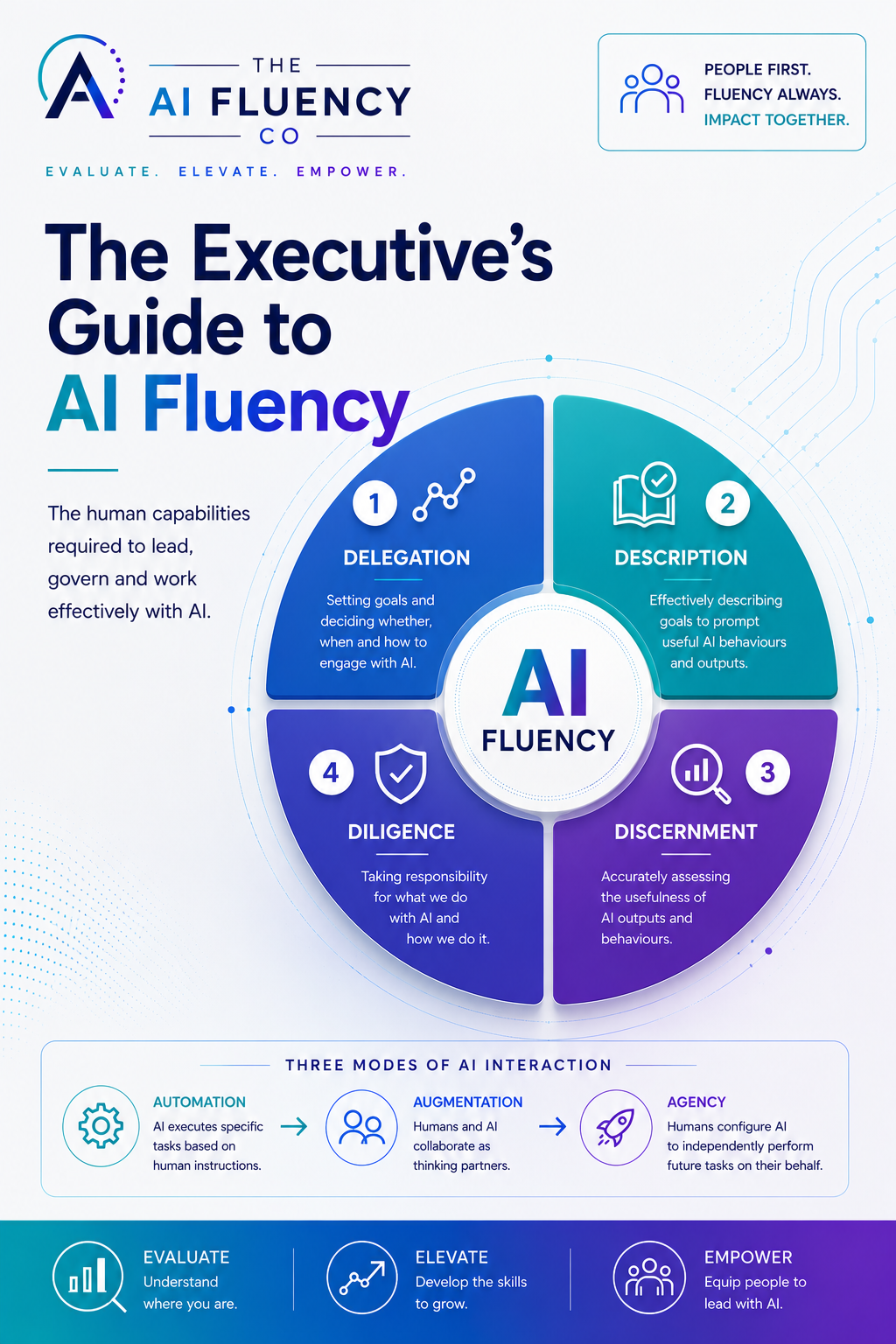
The third guide in the executive AI series.
Boards do not need to become technologists. They do need enough AI fluency to ask better questions, understand the limits of the tools, and make decisions with confidence rather than hype or fear.
This guide helps senior leaders build a practical shared language for AI. It frames fluency as a board capability: the ability to understand what AI can do, where human judgement still matters, what responsible use looks like, and how to connect AI adoption to strategy, governance, risk, and value.
AI fluency is not about knowing every tool. It is about knowing how to think clearly when the tools keep changing.
What's inside.
- Why AI fluency belongs in the boardroom — the leadership capability behind better AI decisions.
- The difference between awareness, literacy, and fluency — and why fluency is the standard executives should aim for.
- The questions directors should be asking — around value, accountability, risk, capability, and adoption.
- How fluency supports governance — connecting board judgement to responsible AI controls and ISO/IEC 42001 readiness.
- Practical next steps — how to build fluency across the leadership team without turning it into a technical training exercise.
Best read alongside the governance and lifecycle guides. Together, the series gives boards a shared language for AI adoption, the governance frame to keep it responsible, and the lifecycle discipline to make it operational.